4 Lessons We Can Learn From “The Best Country in the World”

by , November 30, 2012 — 15 Comments
Norway & US

Imagine a place where paternity leave for both parents is the norm, children get social security, healthcare is free, and the state pays for your wedding ceremony (at least the church and priest) and your funeral. From an American perspective, it sounds hard to imagine—but it’s the reality in Norway. A country of five million people, Norway has one of the highest standards of living in the world, and has been voted the best country to live in for nearly 10 years in a row.

As a human rights lecturer at a New York-based Norwegian institution, Gateway College, I teach university students who are experiencing New York for the first time. Many come from small villages or Norway’s capital city, Oslo, and New York is probably one of the most intense and eye-opening experiences of their lives. It’s been a blast to watch these students grow over the semester, and realize how many lessons they will take from America back to Norway.

But at the same time, we Americans can take some lessons from Norwegian society, too. There is a reason Norway is so successful (and not just because it’s just an oil country), and I would argue there are a few lessons we should take from this Scandinavian country and apply to our thinking and our daily lives.


1. Learning to JanteLoven

The concept of Jante Law is widespread around Scandinavia, but in Norway, it is known as JanteLoven; a code of social behavior emphasizing modesty, collectivity, and social equality. In essence, it suggests that no one is better than another person, and that we should not brag about our skills or be too proud.

It’s hard to imagine JanteLoven in an American context, because we are often so competitive and so focused on our individual accomplishments and goals (I did this, I built that, I achieved this). It took me an entire semester to realize each student’s unique interests, because they didn’t even really talk about themselves for fear of coming off too forward about their work. Students would never say “I,” they would only say “we” to emphasize the collective and the community. And I have to admit, it took a little getting used to.

As their professor, I made sure students understood the American way of networking and speaking up about your accomplishments. But as I’ve learned from the Norwegians, being humble and modest has its place, too. For example, when discussing social problems, students would rarely use their personal anecdotes to relate—they would instead focus on ways of efficiently solving the problem for everyone. And so, when students did speak about their personal experiences, it would have a stronger impact.


2. Celebrating Equality

Norway is also one of the most egalitarian countries in the world—gay couples have equal rights in marriage and employment and Norway is currently number one on the World Economic Forum’s Gender Gap Index. The workforce is made up of 75% women, women occupy one-third of the seats in Norwegian parliament, and in 2003, the parliament passed a law stating that 40% of all companies’ board members must be women.

It’s also the best place in the world to be a mother. Mothers can get 10 months of full pay while on paternity leave, and fathers help out, too—they get 10 weeks of paternity leave during the first year of the child’s life.

These statistics stand in stark contrast to American society, where women make 70 cents to the dollar of men, we rank the 55th country worldwide in political empowerment, and rarely a day goes by that you don’t hear about the gender gap. While this is certainly something that can’t be changed overnight, we could use to keep in mind Norway’s success in this area. Striving for equality makes it easier for the entire society to succeed.


3. Appreciating What You Have

As our own fiscal cliff is all over the news in America, I would also argue that we could take a lesson from Norway, which has a $660 billion Petroleum fund and no national debt.

Granted, it also has some of the highest taxes in the world (about 28% income tax), which support its great social programs. And the cost of living is the highest in the world (a car that retails for $30,000 in the United States would sell for three times the price in Norway). But one thing students often brought up was how poverty and hunger didn’t really exist in Norway, and how eye-opening it was to see the range of different economics and struggles here in New York. What struck me most is that the students genuinely understood their privilege and felt the need to use it for aid and development efforts around the world. And no matter how you feel about government or taxes, having a mindset of appreciating what you have and helping those less fortunate is a good thing.


4. Ga Pa Tur (Take a Walk) 

Ga Pa Tur translates “to take a walk”—with no other goal then actually walking. In Norway, there’s no destination or no rushing—they love just walking, picnicking, or simply experiencing life outside. In America, the idea of doing things “just because” is something we often lose sight of in our constant connectedness and competitive work week. We could certainly adopt the philosophy of Ga Pa Tur—and I’m sure it would help us significantly de-stress and enjoy the little things in life.


While Norway has many great things about it, I also watched my Norwegian students gripped by America and our values—they were fascinated by the “American dream” and questioned whether or not it still held true. They wanted to understand and celebrate American diversity and innovation, they were struck most by the idea that you can be an individual here and do whatever you want, whenever you want.

My students have learned a lot from their experiences in the United States, but more importantly, they immersed themselves in diversity, stepped out of their comfort zone, and challenged themselves to understand a different model of success. And we can all benefit from doing the same.


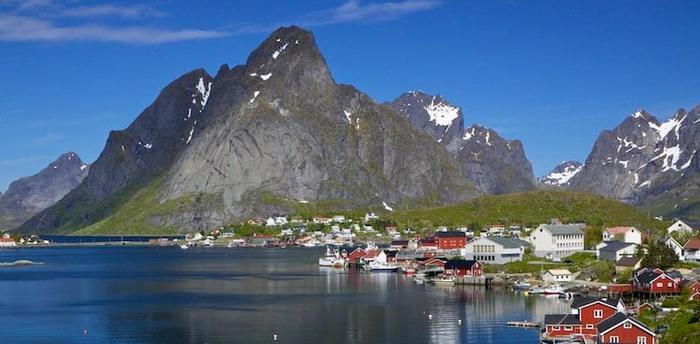
Photo of Norway courtesy of Shutterstock.

About the Author

Natalie Jesionka is lecturer, reporter, and human rights advocate. Natalie has reported and researched issues of human trafficking, child soldiers, and economic and social rights around the world. She is the founder of the The Prizm Project, the first human rights education organization for young women. She lectures on women and war, gender and conflict, and human rights at Rutgers University. When she is not teaching, she is traveling through Southeast Asia or giving lectures about how students and professionals can grow their cultural understanding and media literacy. She also encourages global exploration through Shatter the Looking Glass, an ethical travel magazine that offers travel stories and trip coaching for the best possible travel experiences.

15 comments
TizzAlNabi
TizzAlNabi

It's too bad that they're being overrun by Islamic migrants and are too politically correct to do anything about it

Bas Gresnigt
Bas Gresnigt

Nice article!
Another point: average life expectancy for people in Norway is ~2,5 years more than in USA! 
 

Peter Carruthers
Peter Carruthers

I enjoyed your article Natalie. It is awfully diffcult to encapsulate everything about a country in just a few hundred words, but your impressions resonate with mine. I am a South African who arrived here three years ago after a brief sojourn in the UK. (My wife is Norwegian.)

Regarding the oil, the recent immigrants, the suicide rates, and the like, well I do not think these would relevant to the story you were telling. (And I think your story was all the better for the focus.)

Erik
Erik

I loved the Gå På Tur comment - so true - there is actually a saying that goes: ut på tur aldri sur - ie while on a walk, never angry...

Joe
Joe

Natalie, clearly you should move there. Goodbye!

My Norwegian school mate once told me it took 4-6 MONTHS to get a landline phone installed in Norway. When he moved to the USA he was shocked when the phone company appologised that it would take 3 DAYS for an installer to connect his phone.

A coalition between the Labour Party, Socialist Left Party, and Centre Party, took over government from 17 October 2005 after the 2005 general election. Basically the government of Norway has created a nation of sheep, those who want to live a better life, keep what they earn and be rewarded for success, move out.

Norway has one of the highest costs of living in the world. According to the 2012 Mercer Cost of Living Survey Oslo is the 18th most expensive place in the world for expatriates to live, out of 282 international locations.

There is very little that is considered “cheap” in Norway when compared to European prices. Fresh fish and shrimp is reasonable, but most food is imported into the country, so there is a 14 per cent VAT on food items. That is why many Norwegians DRIVE OVER THE BORDER to Sweden on a harrytur, which is basically a shopping trip to stock up on food staples at 20 per cent less cost. This cross-border industry is so big that several shopping centres have been built just over the border to accommodate Norwegian consumers.

5.526050 krone per dollar

According to The Economist’s Big Mac Index (2009 figures), a Big Mac in Norway cost 40 NOK, or $7.24

USD. That means it’s 72 per cent overvalued!

Three-course dinner in restaurant - 350 NOK per person $63.34

Fast-food meal - 90 NOK per person $16.29

Cup of coffee in bar/café - 40 NOK $7.24

Average male haircut (Western salon) - 350 NOK $63.34

Average female cut and blowdry (Western salon) - 450 NOK $81.43

Petrol 55,50 NOK per gallon - $10.04

Purchase of iPhone 5300 NOK - $1,000.71

Cable TV 359 NOK a month for basic cable - $64.97

carl
carl

Look at suicide rates. In general the further North you go the higher they are, while many "less successful" but tropical or sub tropical countries have dramatically lower suicide rates.

Mark Roberton
Mark Roberton

Living in the UK Germany US and Sweden (now), it confirms what the Swedes say about their neighbour.

I wonder about the sacrifices for living in such a harsh climate though - it may be better to lead a more lucrative successful life in Australia or Brasil and pay out for the benefits in those places!

Food for thought though, maybe I'll give Norway a shot and see for myself.

Rex Remes
Rex Remes

I think having an economy where 25% is created by petroleum and natural gas makes things a bit easier on a country.

aerodott
aerodott

Hi,

Please I will be happy if the worst country in the world too can be case studied on why it is failing and draw a parallel comparism to your country. I think there will be more lesson to learn there especially a country that started from the image of a great country (E.G Nigeria- With the third largest deposit of Iron ore in the world, one or the largest exporter of petroleum product in the world, and 5th largest coal deposit in the world and lots of other resources in sizable international quantity)

Those afore-mentioned resources were not found through exploration, they surfaced E.G people fetching petrol out of ground water and even in a village around Ilesha, Osun state nigeria where gold surfaced as a black shinny soil for centuries until someone that know its gold saw it...etc and so many resources. Even tantalite being behind my house here in Nigeria (International recognized quantity!). And you know what? That is one of the poorest country in the world with the highest paid politicians in the world too, please come and learn from us.

Thank you.

June
June

Hi

A very interesting piece on Norwegian mentality.

Being a Norwegian I can confess that the Jante Law is not a good thing. It is meant to hold down the individual: thou shall not think you are better than us, thou shall not think you can learn us anything. People move from rural areas to towns to get away from this.

We have a very strong sense of collectivity, and think that everyone shall be taken care of, regardless of their finacial situation. We pay tax, and expect to be taken care of when we need. If you take from the collective you must contribute. But much of this you will find in other northern European countries as well.

Rakel
Rakel

Just to play devils advocate... isn't there something to be said about the fact that Norway is so small in compassion to the United states? I think if we focused more on States goverment than Federal then we could have more places in this country like Norway, although I personally don't think socializing everything is the answer. There is much to be said about low taxes and freedom. And the fact that they do have a very high cost of living is definitely something to note ... I doubt we could really transition to that in this country as a whole.

Leif
Leif

"JanteLoven; a code of social behavior emphasizing modesty, collectivity, and social equality. In essence, it suggests that no one is better than another person, and that we should not brag about our skills or be too proud."

The quoted seems to imply in seriousness that the term 'the Jante law/Janteloven' would stand for certain aspects of Norway's social culture. However, actually, the Jante law is a fictionalized and entirely negative concept by the Danish/Norwegian author Axel Sandemose, who formulated the law as a sarcastic joke in a 1930s novel in which he described the parochialism and suppressive social mores in the Danish village were he grow up.

Correspondingly, some of us Scandinavians (not only Norwegians) tend to refer half-jokingly, half seriously, to the Jante law whenever we feel for complaining about our fairly egalitarian national cultures real or imagined restraints. The English language equivalence to the 'Jante law' would be the 'tall poppy syndrome'. Therefore, the Jante law is really not a viable term for the Scandinavian social cultures (or just Norway's), unless one likes to describe them negatively.

Tone
Tone

Hi, really interesting piece! However, when discussing Norwegian tax it seems to escape everybody that we do not have the property tax you have in USA. With 20.000 dollar or more per year, people must leave their homes if they loose their job and steady income. That again may result in families having to uproot the children, which we believe is not good for anybody. But we may be wrong, who knows. So a fifth comment could be that Norwegians, compared to Amercians, very seldom move after establishing a family :-)

Øyvind S
Øyvind S

Please do not tell the law of Jante to be any good. It reads as following:

Thou shalt not think you are anything special.

Thou shalt not think you are as good as us.

Thou shalt not think you are smarter than us.

Thou shalt not convince yourself that you are better than us.

Thou shalt not think you know more than us.

Thou shalt not think you are more important than us.

Thou shalt not think you are good at anything.

Thou shalt not laugh at us.

Thou shalt not think anyone cares about you.

Thou shalt not think you can teach us anything.

As you see, it‘s not about being modest, it’s about suppresing good ideas and self esteem.

Norway also has one of the highest rates of mental problem where an enormous amount of people dont dare to work anymore as they feel it to be such a dramatic failure to work in an ordinary job as a taxi driver, shop assistant, cleaning etc that the fall into deep depression.

Melissa Anderson
Melissa Anderson

I really enjoyed this piece - I had the opportunity to visit Norway as part of a press trip to investigate gender legislation a few years ago, and found it to be a beautiful place full of friendly, interesting people. The country's efforts toward gender equality are fascinating.

That said, I think many discussions of diversity and equality in Norway are missing an examination of recent immigration (particularly of Pakistani and Iraqi people) and how these people are or are not considered "real Norwegians" by the general population. I only spent a week in Oslo, but nearly every person I spoke to brought up the topic of immigration and assimilation, sharing their views on the intersection of socialism and nationalism. (For example, "Should people reap the monetary benefits of Norwegian socialism if they won't enroll their children in Norwegian schools or learn to speak Norwegian?") I only mention this because it was clearly a popular debate at the time (a year before Breivik's horrifying attacks), and I think it could add an interesting dimension to your discussion of JanteLoven. I didn't know the term until I read this piece, but definitely noticed the philosophy. I wonder what its effect is on cultural "outsiders" within Norway?