If you were to land on Earth as an outsider and observe the way we work, you would assume the following: that we are our most creative, prolific selves between 9 AM and 5 PM, that group meetings are bastions of productivity, and that the best way to accelerate thought is by confining it inside walls.
When you think about it that way, our work patterns sound ridiculous. But, decades ago, when we moved from assembling widgets to assembling ideas, we never re-constructed our workspaces to optimize for our work as thinking beings. Instead, we built offices that constricted thought and creativity, and we forced people into patterns that may have been based in reason (the 40-hour work week, for instance, was a carry-over from the worker’s rights movement during the Industrial Revolution), but that have persisted long past the point where they’re effective.
To be fair, there was a time when we needed offices. Making a phone call for work meant you needed to be seated at a desk. Your files could only be found in massive filing cabinets. Your computer—once it finally shrunk down from the size of a room—had to stay on your desk unless you had a side career as a body builder. Almost every piece of equipment you needed made it virtually impossible to work anywhere but the office.
But now, few people would say they’re most productive and creative during a standard workday or in a standard office. There’s significant amounts of research at our fingertips (check out Your Brain at Work by David Rock or The Way We're Working Isn't Working by Tony Schwartz) about how and when the human brain is most productive—and yet, we still largely function in offices that are, at their worst, simply assembly lines with places to sit.
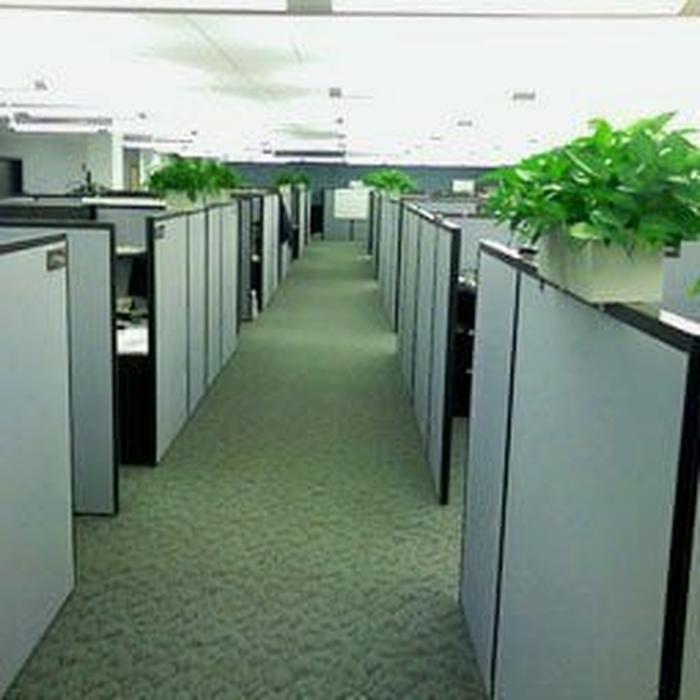
Traditionally, workspaces have been built with limited customization options. Other than a few moveable walls or slightly re-arrangeable furniture, an office stays how it’s built. Companies take different approaches here: Some jam-pack the space with cubicles and individual offices, while others have wide-open spaces with communal areas. But the problem is, both of these extremes are in direct conflict with how our brains work. We actually need different workspaces depending on the time of day, the task at hand, and what exactly we’re trying to accomplish.
Research by Joan Meyers-Levy in 2006, for example, showed that high ceiling height helps us think more broadly and draw more connections between unrelated subjects. Other studies have shown that environments with red as one of the primary colors are conducive to good performance on short-term memory tasks. Environments where employees are surrounded in blue, on the other hand, are more conducive to creativity. Exposure to nature—whether through windows or outdoor space—also has a significant impact, by helping us pay attention and reducing feelings of aggression.
So, the ideal office would be one that offers a variety of different types of space (private individual offices, both structured and relaxed group spaces, areas that can be dedicated to specific projects) and is highly customizable (hmm—color changing walls?). We need spaces where we can have peace and quiet to complete intense thinking tasks, but we also need to have collaborative, open spaces where—to borrow Matt Ridley’s phase—ideas can have sex with each other, allowing them to transform from simple thoughts into something much more substantial.
So where do we go from here? Slowly, the knowledge about how our brains work—once relegated to academic papers—is finally getting the attention it deserves. Companies that have stumbled with the old model are starting to innovate. Of course, cubicles aren’t going to disappear overnight (although that would be an awesome magic trick), but whether you work from home or out of an old-school office, you can do some things to make your workspace more conducive to producing great work.
If you work from home, start by making your space as multi-functional as possible. Stash power strips (with extra power cords if you can) near a few different potential workspaces—a desk or table, or your favorite chair. If you make moving around your space less of a pain, you’ll increase the chances that you’ll actually move. You can also give yourself more options for creative outlet—paint a wall or the back of a door with Idea Paint to give yourself a giant white board, or buy a roll of white butcher paper and suspend pieces from the wall with clips so that you can sketch out ideas.
Or, get out of the house altogether—scope out which coffee shops, restaurants, and other venues in your area offer free Wi-Fi, or think about investing in a mobile hotspot or USB modem so that you can work anywhere that inspires you. Done with coffee places? Try co-working and use a site like Loosecubes to help you locate spaces or offices with extra desks that are often available by the day.
If you’re working out of an office, your choices are more limited, but there are still options. Stuck in a cubicle-laden environment, a former colleague of mine turned part of her cubicle into a reading nook with the help of two floor pillows and a brightly colored piece of fabric. If you find yourself always having meetings cooped up in the same conference room, trying moving them to a different space, or hold the meeting in a coffee place, a park, or while walking around the block.
The bottom line? Think outside the eight-hour, cubicle-confined workday. That cheesy slogan, “work smarter, not harder” is actually on to something.