What We Weren’t Supposed to Learn From Disney Princesses

by , February 3, 2012 — 8 Comments

It’s been a decade or two since I technically should have outgrown them, but I love Disney movies. I still know all the songs. I still have my favorite characters. And I don’t think I’m alone: Everyone has his or her own answer to “what’s your favorite Disney movie”—and most of us are unashamed to admit it.

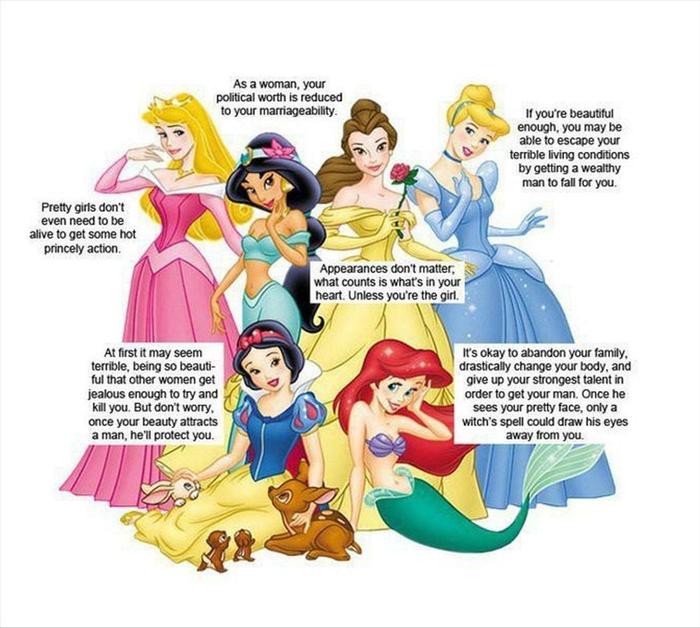
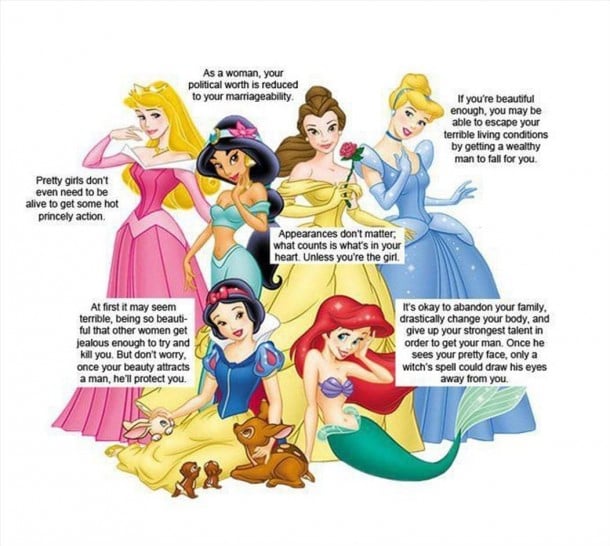
So what do you learn from Disney movies? This picture—that’s recently been circulating the web—promotes one idea: Be beautiful. I have to admit I felt a little sad seeing it, because I detect some uncomfortable truth in those captions next to the characters I automatically want to defend.
120203 Disney Princesses B 610x546 What We Werent Supposed to Learn From Disney Princesses

These princesses do have other, more substantive qualities besides beauty. They are selfless, they are loving, they are smart. But often it is the viewer—not the prince—who sees these qualities and gets to know these kick-ass women. To the prince, the princess starts off—and, in many cases, remains—just a pretty face.

I wonder if the stories would turn out the same way if their heroines were more flawed. Would Cinderella be rewarded if she lost her temper? Would Snow White be saved if she were not so fragilely feminine? If Belle is so smart and good, why must she be beautiful? “Average-looking and the Beast” is a less catchy title, certainly, but would Belle’s love story be the same were she less physically appealing?

Maybe it would. Maybe the princes do love the princesses in the way the viewers do. The more recent movies portray more balanced relationships: the Beast comes to love Belle for her heart and her brain, and Aladdin and Jasmine become rebellious pals (after Aladdin first sees Jasmine’s almond eyes and sexy two-piece, that is). But in many tales, we don’t know if the beauty the Prince beholds is more than skin-deep, because the princess has taken her self-realizing journey in the privacy of her own home, with her animal or fairy friends (seriously, princesses, where are your human friends?)—and it has often excluded her prince.

The filmmakers did not write the classics. They did not concoct these age-old tales. But in the artistic rule-bending that comes with interpreting a story, I wish we could see a heroine who is more “real” looking, who is more flawed, and whose sense of fulfillment extends past her wedding day. And in a story that applies to all modern girl-viewers, I wish the love between a prince and a princess could be equal, mutually saving, and strong—even in the face of imperfection.

About the Author

Molly is The Daily Muse’s resident bookworm. She currently works in communications and is begrudgingly learning to be a grownup. She likes coffee shops and (the bakery aisle of) grocery stores, reading about other places but not necessarily traveling to them, keeping things clean, and stalking the Harvard Opportunes, her beloved college a cappella group. Please help her be a better Tweeter @MHDonovan.

8 comments
Sebastian
Sebastian

Aladdin and Jasmine get married in the third movie, but they should become parents. They should have kids if there was a fourth Aladdin movie.

Vetle
Vetle

The Little Mermaid also teaches us that girls should just be silent and everything will work out for them!

Crystal
Crystal

Are we forgetting Shreck? That is one discusting princess movie! It's sick how our society feels such a strong need to recognize less desirable and less healthy female renditions. Major university's tell students to be happy with themselves - when obesity rates plague the US - morbid!

Molly
Molly

Ann -- I completely agree with you regarding what Hollywood promotes for boys. This piece could have been written from a completely different--if complementary--angle: the minimization of personality in Disney princes. Just as the princesses are selected for their looks, so are the princes selected for theirs: several princesses (Snow White, Cinderella, Sleeping Beauty) fall in love based on a handsome face (on a wealthy prince) alone. While it's completely true that looks do play a factor in attraction, I wish a rounder idea of true love could be promoted for little girls and little boys (and "teams" like Belle and the Beast/Aladdin and Jasmine are encouraging).

Ellen
Ellen

Ann I am offended at what roles Hollywood doles out to both genders, however I think these themes are a reflection of our culture rather than something being imposed upon it/us. Gender-stereotyping puts those little girls And boys who aren't interested in wasting away under the weight of tiaras or fighting with other cowboys at risk of being ostracized. Women in the US are not permitted to be combat soldiers or participate in a military draft. Whatever your opinion on these cultural moores they are limiting our choices.

As a mother-to-be I want my child to feel truly free to express whatever he or she would like through play, not be singled out as te only girl playing with regular (not the new "princess-like") Legos. I have nothing against princesses but they lead to the assumptions we make as adults. As the main-breadwinner in our family I am offended that people assume I will leave my job when our baby is born. Because of the princess-mentality adult Americans assume women don't want to work when they have children. I work in a profession dominated by men an I love my work, motherhood can't change that my profession helps to define who I am. Princessing is not a profession, but police"men", firefighters, and solderiers are real people who do important work. Couldn't we give girls a chance to fantasize about actually helping people rather than lounging in their imaginary palaces?

Ann
Ann

I am a mother of 2 girls, & I am honestly getting sick of this anti princess movement. I am sorry your dreams of becoming a princess did not come true, but really? Why shouldn't girls pretend to live in a castle & have a prince charming? If they think that is a truthful vision of theist futures then shame on the parents. You can't keep blaming movie companies for your child's beliefs. It is up to parents to help them see reality. These are fairy tales. Yes the "men" in these stories are sexually attracted to the girls. Guess what, that is nature. Men use their visual senses first. It doesn't mean that u will be alone & a servant if a man doesn't notice you at first. If girls want to be a princess when they are young let them. It is funny that not a lot of people comment on what Hollywood spews out to the boys. Knights, wizards, military Heros, etc.

Meoskop
Meoskop

I also love the Princesses, however.

The storytellers absolutely did invent these tales. When they chose to take the teeth out of the classic tales, they did so with intent. Cinderella's self effacing long suffering isn't required by the source material. The Little Mermaid is supposed to be a tragedy, after all.

Patti Sewall
Patti Sewall

As a girl who was weaned on Disney's animated features, thanks to a favorite uncle who worked for Disney, I, too, grew up waiting for the glass slipper and all that accompanied it. Maybe, just maybe, Nicolas Cage's character was right in the film Moonstruck, when he told Cher's character, “The storybooks are bulls**t!” Thanks for hitting the nail on the head in this piece: If the heroines were more real, the stories and their endings -- happy or not -- would follow that lead. There are a lot of happy girls out there -- and they are not all princesses.